It's FIGZ time again! On 5th of June, miniature enthusiasts - not only from Benno's figures forum - will come together in Arnhem (Netherlands) to show their miniatures, play wargames and spend money for useful equipment and new stuff.
Plus there will be Dutch food. Plus there will be a painting contest. Plus there will be workshops on how to build trees and buildings in scale 1/72.
You will find more infos on www.figz.nl. I will certainly be there. How about you?
Sunday, May 22, 2016
Sunday, May 8, 2016
Brunswickers ready for groundworks
Today I'm going to start some groundworks again, because my display of Brunswickers must be ready for FIGZ.
I bought some Brunswickers from Schilling figures back at the ISSC show in Heiden last year in order to paint the different uniform patterns of Brunswick troops at the battles of the 100 days campaign. There were guards, line and light infantrymen present at Waterloo and although (except from the light avantgarde infantry) they all wore black uniform, there were little differences between the battalions, such as collar colours and differently coloured stripes on trouser sides.
So finally, I ended up with 9 figures. Putting them into a frame looked somehow odd, especially because I had to make a different factsheet for explaining the difference between these figures. Therefore, I had to go and by some broader wood. And now, I'm ready to finalize this project.
The figures themselve are nicely modelled, although the bajonets look a bit short. They are mounted on very small bases - you have to glue them onto a crown cap or something similar for painting because if you only use tweezers, the figures will snap off time after time.
The reason why I bought them in the first place was that I liked to paint black. There's in fact not much to do about it - paint them dark grey, add dark black shades, highlight folds in mid grey. So much for the theory, because there's much highlighting to be done, folds have to be accentuated carefully and then there are those Hussar-style laces on the uniform breasts that take you some time to be done accurately.
Nevertheless, I like the results. Although I wouldn't like to paint a hundred of these chaps, the ones I painted were fun to paint.
I bought some Brunswickers from Schilling figures back at the ISSC show in Heiden last year in order to paint the different uniform patterns of Brunswick troops at the battles of the 100 days campaign. There were guards, line and light infantrymen present at Waterloo and although (except from the light avantgarde infantry) they all wore black uniform, there were little differences between the battalions, such as collar colours and differently coloured stripes on trouser sides.
So finally, I ended up with 9 figures. Putting them into a frame looked somehow odd, especially because I had to make a different factsheet for explaining the difference between these figures. Therefore, I had to go and by some broader wood. And now, I'm ready to finalize this project.
The figures themselve are nicely modelled, although the bajonets look a bit short. They are mounted on very small bases - you have to glue them onto a crown cap or something similar for painting because if you only use tweezers, the figures will snap off time after time.
The reason why I bought them in the first place was that I liked to paint black. There's in fact not much to do about it - paint them dark grey, add dark black shades, highlight folds in mid grey. So much for the theory, because there's much highlighting to be done, folds have to be accentuated carefully and then there are those Hussar-style laces on the uniform breasts that take you some time to be done accurately.
Nevertheless, I like the results. Although I wouldn't like to paint a hundred of these chaps, the ones I painted were fun to paint.
Tuesday, May 3, 2016
...one month later...
Yesterday I finished the Kingdom of Holland line infantry for my long-run Pre-Bardin uniform project. That's one month after showing you the first pics.
What do you say? I'm really happy with those chaps, I like these colours.
Btw - the pre-Bardin half-breast uniform was officially worn only in a short period during 1806. After that, the closed breast variant was worn which is to be seen on so many planches showing the Dutch troops of that time. Nevertheless, uniforms were not changed 'en bloc' and that means that even the half-breast type was partially worn for some time in parallel to the other dress.
This was, in fact, usual practice in pre-industrialization era armies. Replacement of uniforms usually took quite a long time before it was completely finished. By the way- here's the officer and the drummer for my Kingdom of Holland troop setup.
In parallel, I finished a little single figure vignette for the forthcoming FIGZ in Arnhem next month.
FIGZ is only four weeks ahead - so if you have some time left on June 5th and like to see some really good 1/72 stuff plus lots of wargaming, come and visit FIGZ - entry is free!
What do you say? I'm really happy with those chaps, I like these colours.
Btw - the pre-Bardin half-breast uniform was officially worn only in a short period during 1806. After that, the closed breast variant was worn which is to be seen on so many planches showing the Dutch troops of that time. Nevertheless, uniforms were not changed 'en bloc' and that means that even the half-breast type was partially worn for some time in parallel to the other dress.
This was, in fact, usual practice in pre-industrialization era armies. Replacement of uniforms usually took quite a long time before it was completely finished. By the way- here's the officer and the drummer for my Kingdom of Holland troop setup.
In parallel, I finished a little single figure vignette for the forthcoming FIGZ in Arnhem next month.
FIGZ is only four weeks ahead - so if you have some time left on June 5th and like to see some really good 1/72 stuff plus lots of wargaming, come and visit FIGZ - entry is free!
Friday, April 1, 2016
Dutch, next step
Okay. I'm more and more fed up with the appartment I'm living in when it comes up to photos.
I have no spot in here where I can make proper photos under normal daylight conditions.
I'm not satisfied at all - and I suppose that sooner or later I'll have to build a proper photobox.
In the following case, the contrasts on the white uniforms look harder on the picture then in reality. :-(
What I'm currently working on is the next part of early Kingdom of Holland infantry.
The first three of eight regimental figures are completed, I also have the belonging command and voltigeur figures also under construction. These figures are basically headswaps - voltigeur heads on fusilier bodies, plume cut off, pompom glued onto the right side and shako plate cut off. Which allows me to put the fusilier heads with re-glued plumes onto the voltigeur bodies - as a by-product, I can produce Italian light infantry voltigeurs and grenadiers. Win-win!
Thursday, March 24, 2016
Casualties
Right. Sometimes, you just need some casualties to pimp up your diorama. War is bloody business. And far too few manufacturers give us the figures for a real grim setup of a battlefield.
So if you're looking for a good range of wounded/dead French infantrymen, you should probably have a look for Schilling figures again. Unfortunately, these figures are uniformed in the Bardin uniform with closed breast and therefore only useable for after-1812 scenarios, but as this includes Waterloo as well as the battles of 1813 and 1814, they are still very useful.
Figures come with separate muskets and backpacks - except from this figure which has the backpack still mounted.
These are still not finished, photographed under bad light. Therefore, they don't look that great but I guess it's enough to give you an impression of how they look
I don't have a clue for which exact purpose I'm going to use them. But in fact they already looked so nice un-painted that I just wasn't able to withstand to buy them. ;-)
So if you're looking for a good range of wounded/dead French infantrymen, you should probably have a look for Schilling figures again. Unfortunately, these figures are uniformed in the Bardin uniform with closed breast and therefore only useable for after-1812 scenarios, but as this includes Waterloo as well as the battles of 1813 and 1814, they are still very useful.
Figures come with separate muskets and backpacks - except from this figure which has the backpack still mounted.
These are still not finished, photographed under bad light. Therefore, they don't look that great but I guess it's enough to give you an impression of how they look
I don't have a clue for which exact purpose I'm going to use them. But in fact they already looked so nice un-painted that I just wasn't able to withstand to buy them. ;-)
Sunday, February 28, 2016
French vs. French
When I made up the concept for my Pre-Bardin uniform project, I originally had in mind to depict the uniforms of all the armies which fought in the same uniform as Napoleons French army did. As I went through my research, this concept of painting all possible varieties of that uniform type diversified a lot. For example, I wasn't aware about how many different units with different uniform colours even the Italian army had.
I wasn't aware about how much different varieties of the same uniform were in duty even within the French army itself. And this is why I have to paint at least several different French regiments in order to display that even within an army with common regulations, there was a certain range of variation.
My newest unit is the line infantry regiment no. 30:
What all French line regiments had in common, was the general design of the uniform and the basic colouring. Some regiments directly adopted the shako for grenadiers, some not. Some had the shako rim coloured in the colour of their branch, some not. Etcetera, etcetera...
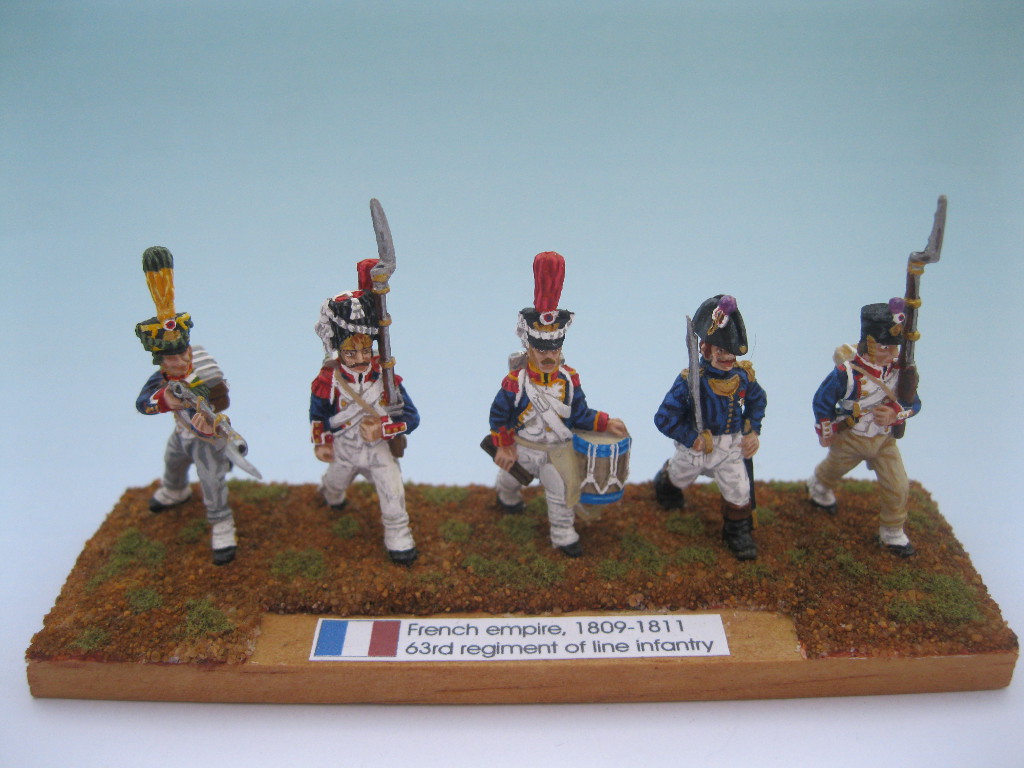
For direct comparizon, here's the 63rd regiment once again:
The main difference throughout all the regiments is the colour of the musicians/drummer uniforms. This may have - if I'm not wrong - have to do with the former distinctive regimental colours worn in reverse order. Whoever has more information about the logic in behind of the drummers' uniform colours, please let me know!
I wasn't aware about how much different varieties of the same uniform were in duty even within the French army itself. And this is why I have to paint at least several different French regiments in order to display that even within an army with common regulations, there was a certain range of variation.
My newest unit is the line infantry regiment no. 30:
What all French line regiments had in common, was the general design of the uniform and the basic colouring. Some regiments directly adopted the shako for grenadiers, some not. Some had the shako rim coloured in the colour of their branch, some not. Etcetera, etcetera...
For direct comparizon, here's the 63rd regiment once again:
The main difference throughout all the regiments is the colour of the musicians/drummer uniforms. This may have - if I'm not wrong - have to do with the former distinctive regimental colours worn in reverse order. Whoever has more information about the logic in behind of the drummers' uniform colours, please let me know!
Monday, February 8, 2016
French departmental guards (reserve infantry)
I'm currently finishing a row of figures for my long-term-PreBardin-Uniform project. Yet I'm not sure how to base them - row by row as I did with the Italian line infantry or as a complete block.
The matter of interest in this case is the French reserve infantry - or departmental guard companies. In 1805, a decree was given out that every prefecture in France had to raise reserve infantry companies. Their strength depended on the population size of the prefecture.
The uniform type and equipment was the same as that of the regular line infantry, but the cloth was dyed in a lighter shade of blue plus the different 'legions' could be distinguished by a certain colour code. Basic colours were white, poppy red, green, yellow, orange, dark red and black. The specific combination of cuffs, collar and breast either being in the distinctive company colour or in light blue defined the belonging legion.
For example, 1st legion had breast, cuffs and collar in white while 15th legion had white breast, but cuffs and collar in light blue. By this colour code, you get 28 different combinations.
So here's the start of it. The rest of white, poppy red and black combinations are still on my desk. The rest will follow.
Usually, all the conscripts for whom there wasn't a place in the regular units, were transferred to the reserve. Apart from being a pool to fill up the ranks of the regular regiments, the reserve companies had an important role as a rearguard. They were the military force the prefects could use to enforce their orders. They guarded important infrastructure, catched criminals and deserters, guarded prisons, cared for the public security and fullfilled a lot of other tasks behind the lines.
As units, the departmental guards were seldom used for battle. There were only some cases in regard to the defensive operations in 1814. In the beginning of that year, the reserve companies were dissolved and their men distributed to the various regular regiments.
The matter of interest in this case is the French reserve infantry - or departmental guard companies. In 1805, a decree was given out that every prefecture in France had to raise reserve infantry companies. Their strength depended on the population size of the prefecture.
The uniform type and equipment was the same as that of the regular line infantry, but the cloth was dyed in a lighter shade of blue plus the different 'legions' could be distinguished by a certain colour code. Basic colours were white, poppy red, green, yellow, orange, dark red and black. The specific combination of cuffs, collar and breast either being in the distinctive company colour or in light blue defined the belonging legion.
For example, 1st legion had breast, cuffs and collar in white while 15th legion had white breast, but cuffs and collar in light blue. By this colour code, you get 28 different combinations.
So here's the start of it. The rest of white, poppy red and black combinations are still on my desk. The rest will follow.
Usually, all the conscripts for whom there wasn't a place in the regular units, were transferred to the reserve. Apart from being a pool to fill up the ranks of the regular regiments, the reserve companies had an important role as a rearguard. They were the military force the prefects could use to enforce their orders. They guarded important infrastructure, catched criminals and deserters, guarded prisons, cared for the public security and fullfilled a lot of other tasks behind the lines.
As units, the departmental guards were seldom used for battle. There were only some cases in regard to the defensive operations in 1814. In the beginning of that year, the reserve companies were dissolved and their men distributed to the various regular regiments.
Subscribe to:
Posts (Atom)